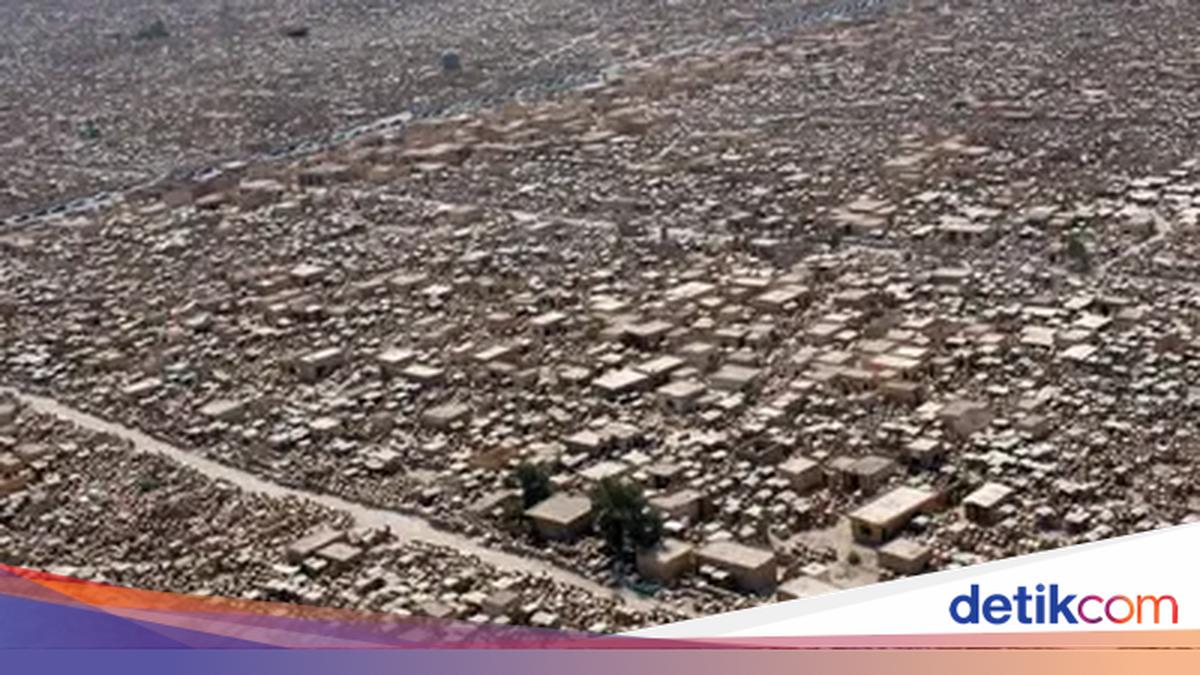
Wadi-us-Salaam: Inside the World’s Largest Cemetery in Iraq
Wadi-us-Salaam in Najaf, Iraq, is the world’s largest cemetery, covering 9.17 square kilometers with an estimated 5 to 6 million bodies, according to Guinness World Records. Known as the “Valley of Peace,” the sprawling burial ground has been in continuous use since the 7th century, creating a vast city-like expanse of graves, mausoleums, and subterranean vaults.
The scale of Wadi-us-Salaam dwarfs traditional urban burial spaces. According to Guinness World Records cited by Riaurealita.com, the 9.17-square-kilometer site is nearly three times the size of New York’s Central Park. From an aerial view, the complex resembles a dense cityscape where the structures are not residential homes or commercial blocks, but tightly packed tombs, mausoleums, and crypts.
Data regarding the exact dimensions of the site varies slightly across institutions. While Guinness World Records records an area of 9.17 square kilometers, satellite imagery from NASA indicates the zone spans roughly 10 square kilometers and holds upward of 6 million graves, as reported by Riaurealita.com. Analysts note that calculating millions of tombs accumulated over more than 14 centuries presents a monumental logistical challenge, making the 5 to 6 million figure an informed historical estimate rather than a modern census count.
Spiritual Significance and the Draw for Shia Pilgrims
The primary driver behind the cemetery’s continuous expansion is its geographic and religious proximity to the shrine of Imam Ali bin Abi Talib, the cousin and son-in-law of Prophet Muhammad and the first imam in Shia tradition. This close alignment motivates millions of Shia Muslims from across the globe to seek burial within the hallowed grounds of Najaf.
Navigating the terrain reveals a stark contrast to its appearance from the air. Visitors encounter a dense labyrinth of narrow, winding alleys flanked by headstones, mausoleums, and burial structures that press tightly against one another.
Layers of History: From Ancient Prophets to Modern Conflicts
Wadi-us-Salaam acts as a physical archive of regional history, recording over a millennium of human conflict, faith, and political upheaval. Historical records indicate the presence of tombs believed to be linked to Hud and Salih, two prophets revered in Islam. More recent layers document the turbulence of the 20th and 21st centuries.
The cemetery holds the grave of Muhammad Baqir al-Sadr, an Iraqi cleric and political activist executed by Saddam Hussein’s government in 1980, as documented by Riaurealita.com. The site also contains designated sections for soldiers killed during the Iran-Iraq War in the 1980s and victims of the Shia uprisings against Saddam Hussein in 1991.
Burial volumes surged during periods of intense national crisis. At the height of the Iraq War, daily interments reached up to 250 bodies. Even later, when extremist groups seized parts of Iraq in 2014, daily burials hovered around 200 per day, according to Riaurealita.com.
Active Operations and Future Expansion Challenges
Unlike ancient ruins or static historical monuments, Wadi-us-Salaam remains an active burial ground. Families continue to utilize diverse vault structures, ranging from simple surface markers to extensive underground family crypts capable of housing multiple generations.

Spanning more than fourteen centuries of continuous use, Wadi-us-Salaam stands as a monumental chronicle of human mortality and faith. As new interments are added daily, the Valley of Peace continues to expand its boundaries, securing its unmatched status in the global landscape of historical and religious landmarks.