NVIDIA Unveils RTX Spark and New Tools to Accelerate Local AI Agents
NVIDIA Accelerates Local AI at IFA 2026 with RTX Spark PCs and New Agent Tools
Frontier intelligence is going local as NVIDIA, Microsoft, and hardware partners team up at IFA 2026 to accelerate local inference and simplify agent deployment on NVIDIA hardware. Unveiled alongside compact Windows PCs arriving in October, the new software stack targets the latency and hardware bottlenecks that have historically slowed down local agentic workflows.
The Tech TL;DR:
- Local Agent Setup: Hermes Agent, OpenClaw, and Perplexity Portable Computer now feature one-click local model configuration built on llama.cpp and NVIDIA inference optimizations.
- Inference Speedups: Llama.cpp kernel optimizations deliver up to 1.9x higher throughput on GeForce RTX 5090 hardware, while vLLM gains up to 1.4x improvements across DGX Spark clusters.
- Hardware Expansion: NVIDIA RTX Spark Windows PCs launch in October 2026 featuring 1 Petaflop RTX Blackwell GPUs, Grace CPUs, and up to 128GB of unified memory.
Eliminating Setup Friction for Local AI Agents
Running autonomous agents locally has traditionally demanded manual intervention, from selecting quantization parameters to managing compatible inference servers. According to NVIDIA developer documentation, those configuration hurdles are shrinking across RTX and DGX systems through direct integrations with leading open-source agent applications. Users can execute multi-step engineering, finance, or startup tasks locally without burning API credits, while retaining the option to escalate complex reasoning tasks to one of over 15 cloud-based frontier models only after explicit user authorization.

Perplexity Portable Computer is expanding beyond Linux systems like the NVIDIA DGX Spark to support Windows PCs equipped with NVIDIA RTX GPUs featuring at least 24GB of VRAM. The application packages models, orchestration tools, and runtime environments into a single binary.
Concurrently, Nous Research has integrated one-click setup for Hermes Agent across Windows-based RTX and DGX hardware. The system automatically detects the local NVIDIA GPU, provisions the correct quantization profile via llama.cpp, and initializes background tasks without manual model downloads. Similarly, the OpenClaw Windows App now optimizes onboarding for its community-driven agent framework on GPUs with 24GB or more VRAM.
Hardware Benchmarks and Inference Architecture
Under the hood, raw inference speed remains the primary determinant of agent responsiveness. Through collaborative engineering efforts with the open-source communities behind llama.cpp and vLLM, NVIDIA has pushed throughput boundaries across consumer and enterprise tiers. Llama.cpp achieves up to 1.9x higher token generation rates on a GeForce RTX 5090 using enhanced speculative decoding and prefill optimizations. Meanwhile, vLLM records a 1.2x boost on RTX PRO 6000 Blackwell Workstation Editions and up to 1.4x across dual DGX Spark clusters, aided by XQA attention kernels in FlashInfer.

Complementing these single-node gains is NVIDIA Personal AI Router (PAIR), an open-source utility designed to tap idle computing power across local networks. As agentic workloads spawn parallel subtasks, single-GPU bottlenecks can stall execution. PAIR automatically discovers network-connected systems running Ollama or LM Studio, routing independent inference requests dynamically based on real-time device capacity. Supporting GeForce RTX 20 series hardware and newer, RTX PRO workstations, DGX Spark, and Apple M4 silicon, PAIR scales local compute availability without manual load balancing.
Expanding Model Ecosystems and RTX Spark Hardware
August 2026 introduced a wave of open-weight models optimized for local deployment. Meta released Muse Glimmer, a 30-billion-parameter coding agent model, alongside Nemotron 3.5 Lightning. Z.ai launched GLM-5.3-Flash, and Qwen introduced Qwen3.8-Flash-Next alongside Qwen3.8-27B. For video generation workloads, LTX 2.5 and MiniMax-H3 now leverage NVFP4 quantization and FastVideo enhancements to run locally on RTX GPUs and DGX stations, with FastVideo’s distilled FastH3 recipe yielding a 7x performance jump.
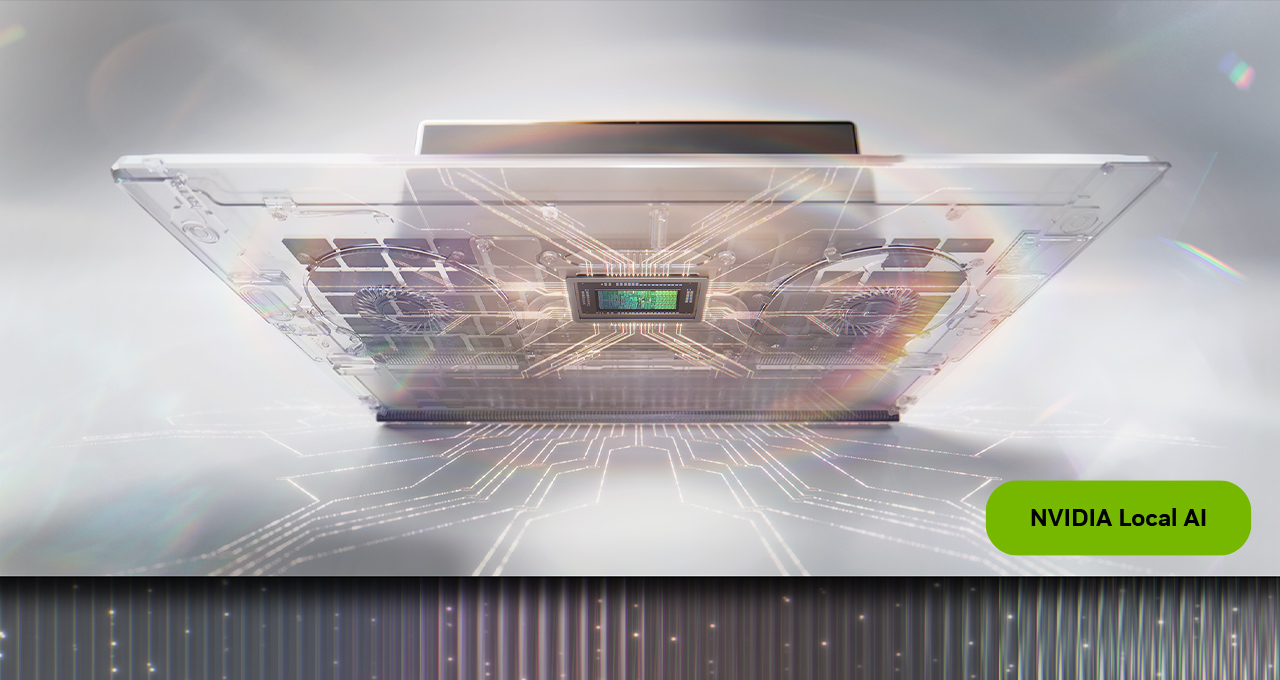
These models find their primary consumer showcase in the newly announced NVIDIA RTX Spark Windows PCs, scheduled to hit shelves in October 2026. Featuring designs from OEMs including Acer, Lenovo’s Yoga Pro 9n, and Yoga 9n 2-in-1, the RTX Spark architecture pairs a 1 Petaflop RTX Blackwell GPU with a 20-core Grace CPU and up to 128GB of unified memory. Creative software is adapting rapidly to this silicon; CyberLink’s PhotoDirector 365 introduces an AI PC Mode utilizing TensorRT-RTX and FP8 acceleration for on-device diffusion tasks.
Implementation: Initializing Local Inference via CLI
llama-server
  --model ./models/nemotron-3.5-lightning.gguf
  --n-gpu-layers 83
  --tensor-split 0
  --ctx-size 8192
  --batch-size 512
  --ubatch-size 128
  --flash-attn on
  --port 8080
This configuration initializes the model with hardware-accelerated flash attention layers fully offloaded to the local NVIDIA GPU, minimizing host-to-device memory transfer latency during continuous agent execution cycles.

Editorial Kicker
The consolidation of high-bandwidth memory, unified architectures, and streamlined agent wrappers signals a definitive shift away from mandatory cloud dependency for complex automation. As hardware standards solidify around systems like RTX Spark, the engineering challenge pivots from merely getting models to run locally to orchestrating multi-agent networks securely across local and edge topologies. For enterprise architects, successfully integrating this hardware wave will require close collaboration with specialized AI systems integration and infrastructure engineering firms to build resilient, low-latency deployment pipelines.
*Disclaimer: The technical analyses and security protocols detailed in this article are for informational purposes only. Always consult with certified IT and cybersecurity professionals before altering enterprise networks or handling sensitive data.*