Did Life Come From Space? Asteroid Samples Reveal Building Blocks of Life
Asteroid samples returned to Earth by space missions contain amino acids, nucleobases, and organic sugars that form the fundamental building blocks of life. Laboratory analyses of material collected from space rocks Bennu and Ryugu reveal complex organic compounds, renewing scientific debate over whether the chemical precursors to biology arrived on early Earth via cosmic impacts.
Sample Analysis Identifies Organic Compounds in Asteroid Ryugu
The Japan Aerospace Exploration Agency spacecraft Hayabusa2 delivered 5.4 grams of material from the asteroid Ryugu to Earth in December 2020. Subsequent laboratory testing of the returned sample identified more than twenty different amino acids alongside uracil, which functions as a primary building block in RNA sequences.
These findings provided early physical evidence that carbon-rich asteroids carry chemical precursors capable of supporting biological structures.
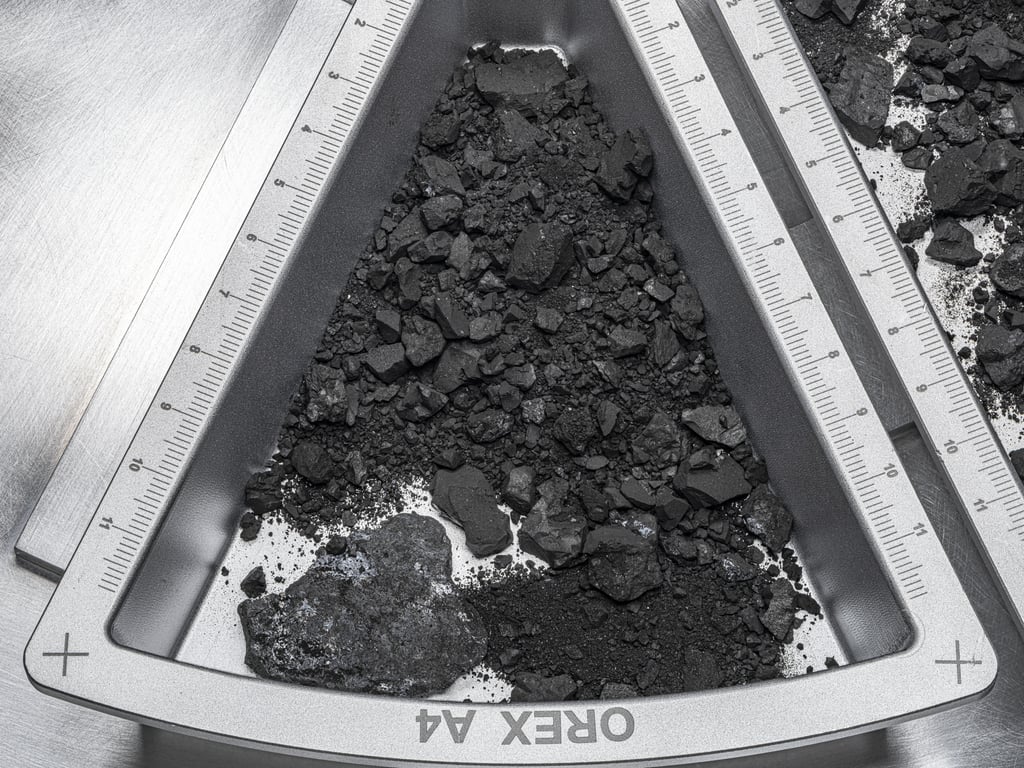
NASA OSIRIS-REx Mission Recovers Bennu Samples
NASA’s OSIRIS-REx mission expanded upon these findings by delivering 121.6 grams of material from the asteroid Bennu to the Utah desert in September 2023. Comprehensive analyses released in January 2025 confirmed the presence of 14 of the 20 amino acids utilized by earthly organisms to construct proteins, alongside all five fundamental nucleobases that form DNA and RNA.
Laboratory examination of the Bennu samples also uncovered trapped ammonia and salts left behind by evaporated water, indicating that the parent asteroid once hosted liquid water activity. Jason Dworkin, project scientist for OSIRIS-REx at NASA’s Goddard Space Flight Center, described the material by telling BBC Science Focus to “think of it as mud.” In December 2025, researchers further identified ribose—the sugar component forming the backbone of RNA—as well as glucose within the Bennu collection.
Evaluating the Panspermi Hypothesis and Chemical Asymmetry
While the recovery of space-borne organic matter aligns with the panspermia hypothesis—the theory that comets and asteroids delivered the raw ingredients of life to the young, molten Earth—scientists caution that raw chemistry differs fundamentally from self-replication. Dworkin noted that laboratory synthesis remains more complex than merely mixing chemical components, pointing out that amino acids extracted from Bennu occur in equal proportions of left-handed and right-handed molecular configurations.

In contrast, terrestrial life almost exclusively utilizes left-handed amino acids. This biochemical preference indicates that while asteroids may have supplied the chemical inventory, the specific assembly mechanisms required to ignite biology originated on Earth or required selective catalysts not present in the space rocks.
Historical Theories and Modern Planetary Protection Protocols
The concept of directed panspermia—the hypothesis that an advanced extraterrestrial civilization deliberately seeded Earth with microorganisms—was famously proposed in 1973 by DNA co-discoverer Francis Crick and chemist Leslie Orgel. Their proposal argued that the universality of the genetic code across all terrestrial organisms resembles a single initial shipment. British astronomers Fred Hoyle and Chandra Wickramasinghe subsequently expanded upon panspermia theories, though such proposals historically marginalized proponents within mainstream scientific circles.

Today, astrobiologists evaluate cosmic delivery theories with renewed seriousness due to the discovery of extremophiles—microbial organisms capable of surviving extreme cold, radiation, and vacuums. Ongoing preparations for crewed and robotic missions to Mars have forced space agencies to implement strict planetary protection protocols to prevent accidental biological contamination between worlds. Analyses of Bennu and Ryugu confirm that neither sample contains living organisms or evidence of an artificial sender, leaving the precise origin of terrestrial life an open scientific inquiry.